What AI Product Research Actually Looks Like (No Hype, Real Output)
Sean Travis
Founder · Kaldon
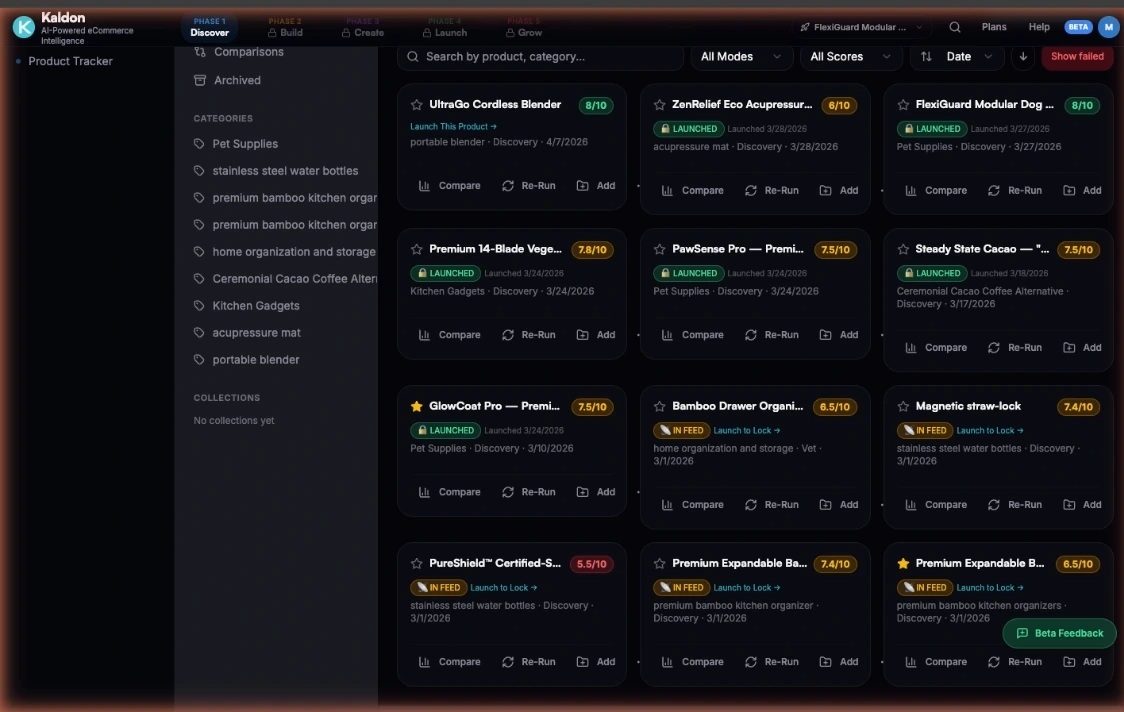
Every product research tool claims to use AI now. Most of them mean "we added a chatbot" or "we use GPT to rewrite product descriptions." That is not AI product research. That is AI window dressing.
Real AI product research means the AI does the analysis, not just the writing. It means the AI evaluates data from multiple sources, identifies patterns a human would miss, and generates actionable recommendations. Not summaries. Recommendations.
This article shows you exactly what a real AI-powered product analysis looks like. We ran an analysis on "premium insulated water bottles" in Kaldon and we are going to walk through every section of the report with honest commentary.
Section 1: The Viability Score
The first thing you see is a number: the viability score. Ours came back at 87 out of 100.
This score is not a random number. It is a weighted composite of demand strength, competition intensity, margin potential, trend trajectory, brand opportunity, and market timing. Each factor is scored independently and then combined using a model trained on thousands of product launches.
What makes this different from Jungle Scout's Opportunity Score: Jungle Scout's score is based primarily on Amazon data (demand, competition, listing quality). Kaldon's score incorporates Amazon data plus Walmart data, Google Trends, social media sentiment, and DTC market signals. It is a multi-marketplace assessment, not a single-channel estimate.
Honest take: The score is useful as a quick filter. If something scores below 50, do not waste your time. If it scores above 80, dig deeper. But do not make a $10,000 inventory decision based on a single number. Read the full report.
Section 2: AI Product Mockups
The report includes 4 AI-generated product images showing your potential product in realistic settings. For our water bottle analysis, we got: a studio shot on white background, a lifestyle shot at a gym, an outdoor adventure shot, and a flat-lay with accessories.
Why this matters: Before Kaldon, you needed physical samples ($200-500) and a photographer ($300-1,000) to create marketing materials. AI mockups let you test marketing concepts, validate positioning, and even run pre-launch ads before you spend a dollar on manufacturing.
Honest take: The mockups are good enough for social media testing and landing page validation. They are not good enough for your final Amazon listing (you will still want professional photography for that). But for the research and validation phase, they save you weeks and hundreds of dollars.
Section 3: Market Analysis
This section breaks down the competitive landscape with data you would normally spend hours compiling manually:
- Top 10 competitors with revenue estimates, review counts, and pricing
- Market size and growth trajectory
- Seasonal demand patterns
- Price distribution analysis (where the market clusters)
- Review sentiment analysis (what customers love and hate)
What makes this different: Traditional tools give you a spreadsheet of competitors. Kaldon gives you a narrative analysis that identifies patterns. For example, our report noted that "the premium segment ($35-50) is underserved, with only 2 of the top 10 sellers positioned above $30, despite review sentiment indicating strong willingness to pay for better insulation and design."
Honest take: The market analysis is genuinely impressive. It surfaces insights that would take an experienced researcher 2-3 hours to compile manually. The AI is particularly good at identifying gaps in the competitive landscape that are not obvious from raw data.
Section 4: The Action Plan
This is where Kaldon diverges most sharply from traditional research tools. Instead of leaving you with data and saying "good luck," the report generates a prioritized action plan.
The action plan is organized into priority tiers:
- Immediate (Week 1-2): Validate the opportunity, define your differentiation, start brand development
- Short-term (Week 3-4): Source samples, finalize brand identity, create initial content
- Medium-term (Month 2-3): Order inventory, build store, launch marketing
- Ongoing: Optimize listings, scale ads, expand to new channels
Each action item includes specific guidance, not generic advice. Instead of "optimize your listing," you get "target these 5 keywords in your title, emphasize insulation duration in bullet point 1, and use lifestyle imagery showing outdoor use."
Honest take: The action plan is the most valuable part of the report for new sellers. Experienced sellers will find some of the advice obvious, but even veterans appreciate the structured timeline and the specific keyword and positioning recommendations.
Section 5: AI Coaching
After the report, you can ask the AI follow-up questions. This is not a generic chatbot. It has context from your specific analysis and can answer questions like:
- "What if I want to target the premium segment instead of mid-range?"
- "How should I differentiate from the top 3 competitors?"
- "What is the best launch strategy for this specific market?"
Honest take: The coaching is useful for new sellers who need guidance on next steps. It is less useful for experienced sellers who already know what to do. The AI occasionally gives generic advice when you ask very specific tactical questions, but for strategic direction, it is solid.
What You Do Not Get
In the interest of fairness, here is what Kaldon's analysis does not include:
- Real-time keyword rank tracking: Helium 10 is better for monitoring your existing listings' keyword positions over time.
- Supplier database: Jungle Scout has a built-in supplier finder. Kaldon does not. You will still need to source your own manufacturer.
- Amazon PPC management: Helium 10's Adtomic is a dedicated PPC tool. Kaldon's ad management is broader (multi-channel) but less granular for Amazon-specific PPC.
The Bottom Line
AI product research is not magic. It does not guarantee success. But it compresses weeks of manual research into minutes and surfaces insights that are genuinely difficult to find on your own.
The best way to evaluate it is to try it. Run an analysis on a product you have already researched manually. Compare the depth, the insights, and the actionability. If the AI tells you something you did not already know, it is worth the investment.
Run your first free analysis and judge the output for yourself. No credit card required.
See the pipeline for yourself.
Start with 2 free analyses. No credit card required.