How to Find a Winning Product to Sell Online (Complete 2026 Guide)
Sean Travis
Founder · Kaldon
Finding a winning product is the single most important decision in your eCommerce journey. Get it right, and everything downstream becomes easier: branding, content, marketing, sales. Get it wrong, and no amount of marketing spend will save you.
This guide walks you through the complete product research process in 2026, from initial idea generation to final validation. No fluff. No theory. Just actionable steps.
Step 1: Start with Problems, Not Products
The biggest mistake new sellers make is starting with a product category and trying to find a gap. Instead, start with problems people are willing to pay to solve.
Where to find problems:
- Amazon reviews (3-star reviews are gold: the product works but has specific complaints)
- Reddit communities (r/BuyItForLife, r/AmazonSeller, niche subreddits)
- TikTok comments on product review videos
- Facebook groups for specific hobbies or demographics
- Your own life (what products have you been disappointed by recently?)
Write down 10-20 problems. Do not filter yet. Quantity first, quality later.
Step 2: Validate Demand with Data
A problem is only worth solving if enough people have it and are actively searching for solutions. This is where data comes in.
Key metrics to evaluate:
- Search volume: How many people search for this product category monthly? You want at least 5,000 monthly searches on Amazon for the primary keyword.
- Competition density: How many sellers are competing? Look for categories with fewer than 500 results for the primary keyword.
- Average revenue: What are the top 10 sellers making monthly? You want to see at least $10,000/month for the top sellers.
- Review velocity: How fast are new reviews accumulating? High velocity means active demand but also active competition.
- Price point: The sweet spot for new sellers is $20-60. High enough for healthy margins, low enough for impulse purchases.
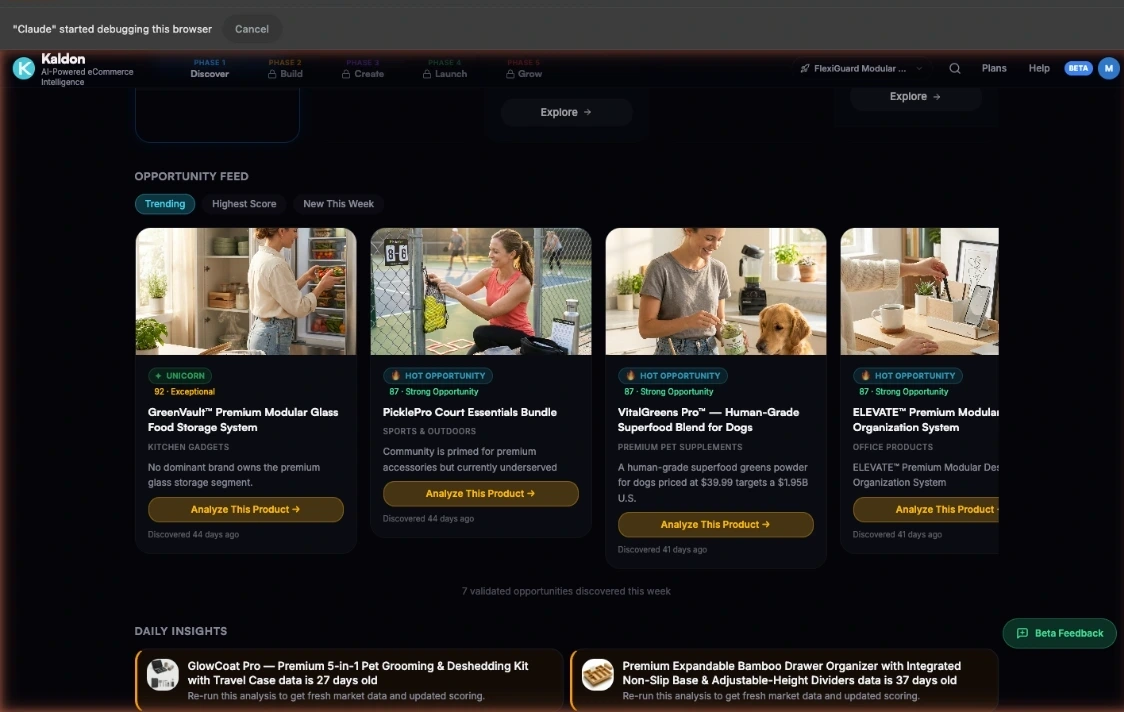
This is where AI-powered research tools change the game. Instead of manually pulling data from multiple sources and building spreadsheets, platforms like Kaldon run 9 parallel AI engines across Amazon, Walmart, and DTC to generate a comprehensive viability score in minutes.
Step 3: Analyze the Competition
Finding demand is not enough. You need to understand who you are competing against and whether you can differentiate.
Competitive analysis checklist:
- Who are the top 5 sellers? Are they big brands or small sellers?
- What are their weaknesses? (Read their 1-3 star reviews)
- What is their brand quality? (Professional photos, consistent branding, or generic?)
- What is their content strategy? (Social media presence, blog, email list?)
- What is their pricing strategy? (Premium, mid-range, or race to the bottom?)
You are looking for categories where the competition is beatable. If the top 5 sellers all have 10,000+ reviews, professional brands, and aggressive pricing, move on. If they have mediocre branding, inconsistent content, and room for a premium positioning, you have found your opportunity.
Step 4: Calculate Your Unit Economics
Before you fall in love with a product, make sure the math works.
The unit economics formula:
Selling Price - (Product Cost + Shipping + Amazon Fees + Marketing Cost) = Profit per Unit
Target a minimum 30% profit margin after all costs. For a $40 product, that means your total cost (product + shipping + fees + marketing) should be under $28.
Common cost breakdown for a $40 product:
- Product cost: $8-12 (from manufacturer)
- Shipping to Amazon: $2-4 per unit
- Amazon FBA fees: $6-8
- Amazon referral fee: $6 (15%)
- PPC advertising: $4-6 per unit (at launch)
- Total cost: $26-36
- Profit: $4-14 per unit
If the margins are tight at the $40 price point, consider whether you can justify a higher price with better branding, bundling, or premium positioning.
Step 5: Validate Before You Invest
Do not order 1,000 units based on spreadsheet data alone. Validate first.
Validation methods:
- Landing page test: Create a simple landing page describing your product. Run $50-100 in Facebook/Instagram ads. Measure click-through rates and email signups.
- Pre-order campaign: List the product on your own store with a "pre-order" button. If people are willing to pay before the product exists, you have validated demand.
- Social media test: Post about the product concept on relevant social media. Measure engagement and direct messages asking where to buy.
- AI product mockups: Use AI to generate realistic product images before you have physical samples. This lets you test marketing materials without manufacturing costs.
Kaldon's analysis reports include AI-generated product mockups that you can use for validation testing before investing in physical samples or manufacturing.
Step 6: Build the Brand Before You Build the Product
This is the step most sellers skip, and it is the step that separates successful launches from failed ones.
Before you contact a manufacturer, define your brand:
- Brand name: Memorable, available as a domain, not too similar to competitors
- Visual identity: Logo, color palette, typography that communicates your positioning
- Brand voice: How does your brand sound? Professional? Playful? Technical? Warm?
- Positioning: Why should someone choose you over the 50 other options?
A strong brand lets you charge premium prices, build customer loyalty, and expand into new products under the same umbrella. It is the difference between selling a commodity and building a business.
Step 7: Plan Your Launch
A product launch is not "list it and hope." It is a coordinated campaign across multiple channels.
Launch checklist:
- Optimized product listing (title, bullets, description, images, A+ content)
- 30 days of social media content scheduled across platforms
- Landing page with email capture for direct traffic
- Email sequence for leads captured during pre-launch
- PPC campaign structure with keyword targets
- Review generation strategy (follow-up emails, inserts)
This is where the connected pipeline approach pays off. When your research data flows into your brand, your brand flows into your content, and your content flows into your store, the launch is not a scramble. It is a sequence.
The Bottom Line
Finding a winning product in 2026 is not about luck. It is about following a systematic process: identify problems, validate demand with data, analyze competition, verify unit economics, validate before investing, build the brand, and plan the launch.
The sellers who succeed are not the ones with the best product ideas. They are the ones with the best process. And the best process is one where every step feeds the next.
Start with a free product analysis and see what a data-driven approach to product research looks like.
See the pipeline for yourself.
Start with 2 free analyses. No credit card required.