Amazon to DTC: How to Build a Brand Beyond the Marketplace
Sean Travis
Founder · Kaldon
You are selling on Amazon. Maybe $5,000 a month. Maybe $50,000. The revenue is real, but so is the anxiety. Because deep down, you know the truth: you do not have a business. You have a listing on someone else's platform.
Amazon can change a policy overnight and cut your revenue in half. They can suspend your account for a vague "policy violation." They can introduce an Amazon Basics version of your product and push you to page 3. You have no customer data, no email list, no brand relationship. You are renting shelf space in someone else's store.
Building a DTC (direct-to-consumer) presence is not optional anymore. It is survival. Here is how to do it without losing your mind.
Why Amazon Sellers Struggle with DTC
The transition from Amazon to DTC is hard because the skills are completely different.
On Amazon, you need: keyword optimization, PPC management, review velocity, inventory management. The marketplace brings the traffic. You just need to capture it.
On DTC, you need: brand identity, content strategy, social media presence, email marketing, paid acquisition, conversion optimization, customer retention. You bring the traffic. The brand captures it.
Most Amazon sellers try to go DTC by opening a Shopify store and running Facebook ads. They spend $2,000 on ads, get 3 sales, and conclude that DTC does not work. But the problem was not DTC. The problem was that they skipped the brand-building step.
The Brand-First Approach
Before you spend a dollar on ads or build a single landing page, you need a brand. Not just a logo. A complete brand identity that communicates who you are, who you serve, and why you are different.
A complete brand identity includes:
- Visual identity: Logo, color palette, typography, image style
- Brand voice: How you sound in writing. Professional? Casual? Technical? Warm?
- Positioning: Your unique angle. What makes you different from the 50 other sellers in your category?
- Story: Why does your brand exist? What problem are you solving? Why should anyone care?
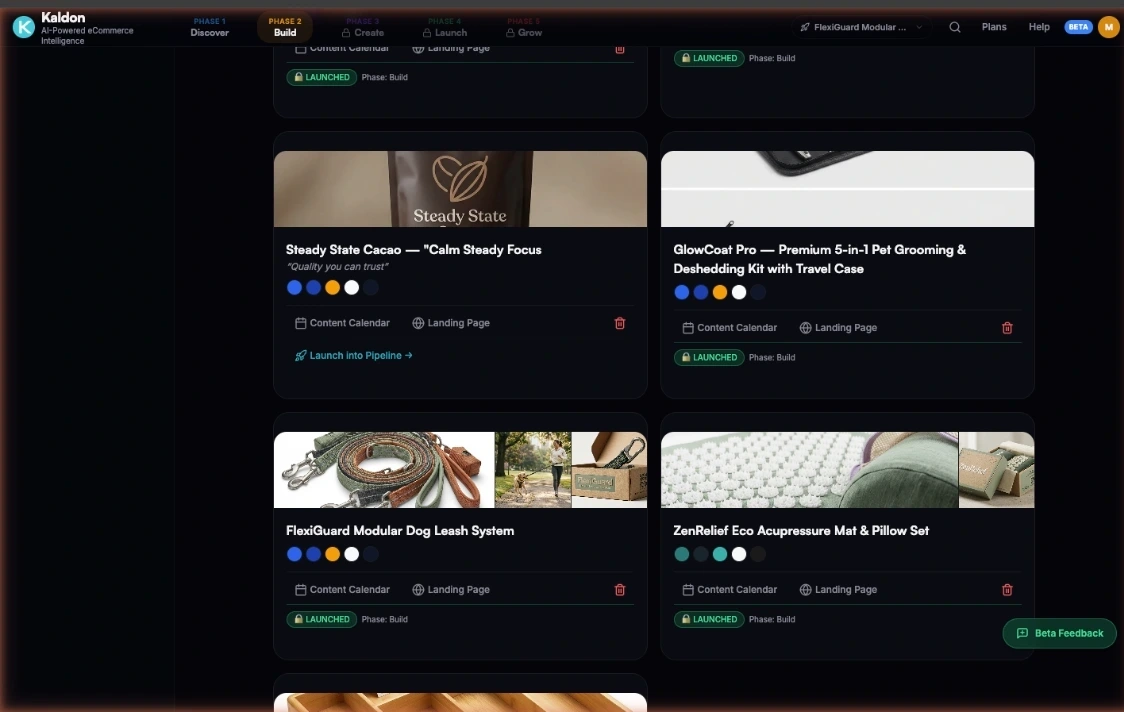
This used to require hiring a branding agency ($5,000-15,000) or spending weeks in Canva. Now, AI can generate a complete brand identity from your product data in minutes. Kaldon's Brand Vault takes the data from your product analysis and generates logo concepts, color palettes, typography pairings, and voice guidelines automatically.
The Content Engine
Once you have a brand, you need content. Lots of it. Consistently.
DTC brands live and die by content. Your Instagram, TikTok, Facebook, Pinterest, and LinkedIn presence is your storefront. If it is empty, inconsistent, or off-brand, customers will not trust you enough to buy directly.
The content formula for DTC:
- 3-5 social posts per week across 2-3 platforms minimum
- 1-2 blog posts per month for SEO and authority
- Email sequences for welcome, abandoned cart, post-purchase, and win-back
- Video content for product demos, unboxings, and behind-the-scenes
This is where most Amazon sellers give up. Creating 15-20 pieces of content per week is a full-time job. Unless you have a system that generates it from your brand data automatically.
The Store Experience
Your DTC store is not just a checkout page. It is a brand experience. Every element should reinforce your positioning and build trust.
Essential DTC store elements:
- Professional product photography (or AI-generated mockups)
- Compelling product descriptions that match your brand voice
- Social proof (reviews, testimonials, press mentions)
- Email capture with a compelling offer
- Blog for SEO traffic and authority
- Mobile-optimized checkout
The key insight is that your store should feel like an extension of your social media presence. When someone clicks from your Instagram to your store, the experience should be seamless. Same colors, same voice, same energy.
The Traffic Strategy
On Amazon, traffic is built in. On DTC, you have to earn it. There are three channels that work for new DTC brands:
1. Organic social media. This is free but takes time. Post consistently, engage with your audience, and let the algorithm work. TikTok is the best platform for new brands because the algorithm favors content quality over follower count.
2. Paid social. Facebook and Instagram ads are the most predictable way to drive DTC traffic. Start with $20-50/day, test 3-5 ad creatives, and scale what works. The key is having enough creative assets to test. This is where AI-generated content pays for itself.
3. SEO. Blog content that targets long-tail keywords in your niche. This takes 3-6 months to pay off but provides free, compounding traffic. Write about the problems your product solves, not just the product itself.
The Connected Approach
The reason most Amazon-to-DTC transitions fail is fragmentation. Sellers try to build a brand in Canva, write content in Jasper, schedule posts in Later, build a store in Shopify, and run ads in Meta. Nothing connects. Everything is manual. The brand voice drifts. The visual identity is inconsistent. The customer experience is disjointed.
The connected approach means your product data flows into your brand, your brand flows into your content, your content flows into your store, and your store data flows into your ads. One platform. One data model. One brand experience.
Start Today
You do not need to leave Amazon to start building DTC. In fact, you should not. Keep your Amazon revenue flowing while you build your brand presence in parallel.
Start with a product analysis on your best-selling Amazon product. Use the data to generate a brand identity. Create a month of content. Build a landing page. Start capturing email addresses. Then, when you are ready, deploy your store.
The goal is not to replace Amazon overnight. It is to reduce your dependency on any single channel so that when Amazon changes a policy, you shrug instead of panic.
Start with a free analysis of your existing product and see what your brand could look like.
See the pipeline for yourself.
Start with 2 free analyses. No credit card required.